
All those hands
Three pictures taped to my wall

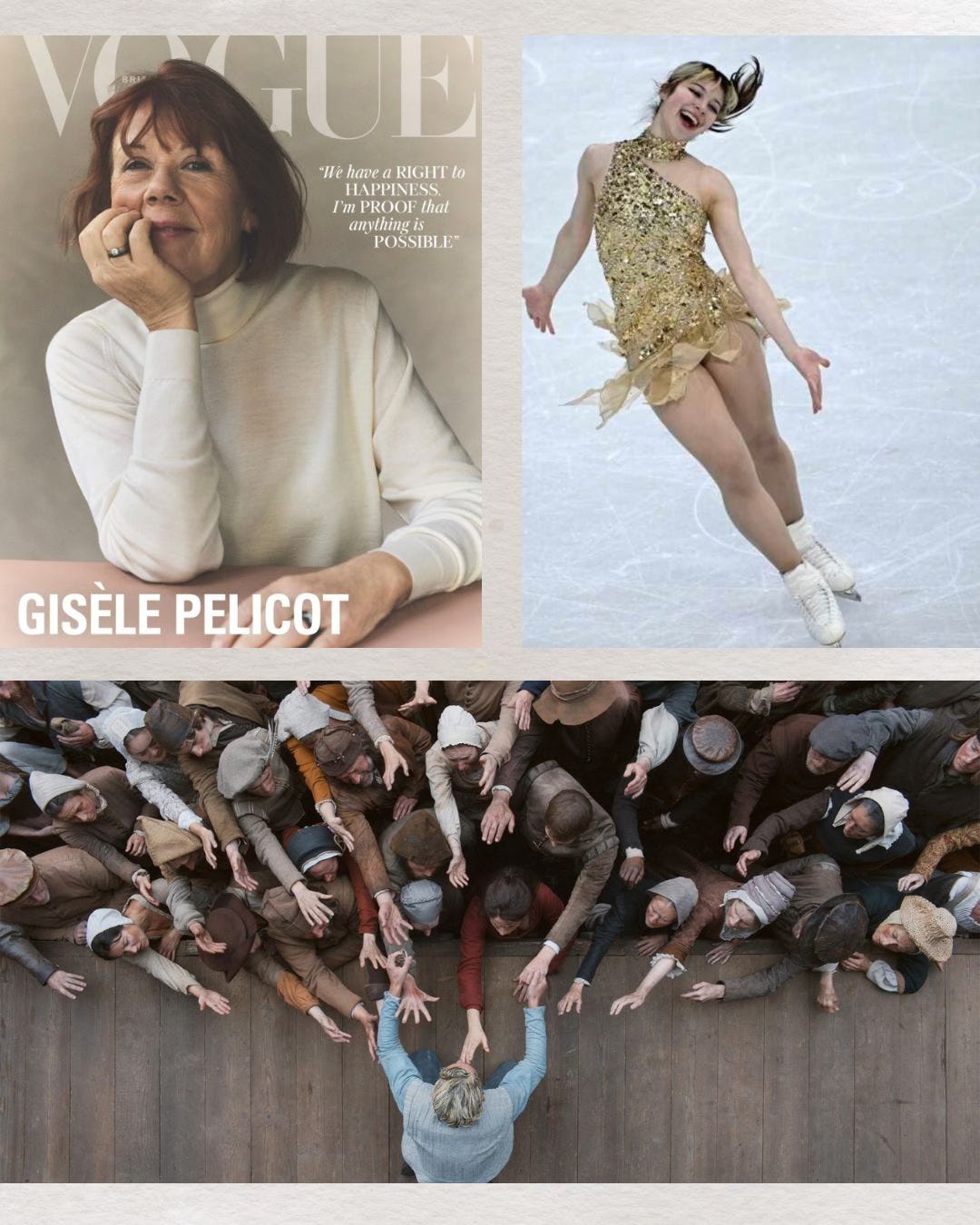
(British Vogue, AP/Getty, Hamnet/The Atlantic)
I taped three pictures above my desk last week. I found them on different corners of the internet but putting them together got me really feeling and thinking. They represent what I want to feel and to think.
The first is Gisèle Pelicot on the cover of British Vogue, her chin resting in her hand, looking directly at the camera. You know her. She’s the woman who, after discovering her husband had drugged her and invited up to seventy men to sexually abuse her in their home for over nearly a decade, chose to take them all to trial and to make that trial public. She waived her right to anonymity so that, as she put it, shame could change sides. And now here she is on the cover of Vogue, not in spite of what happened to her but after it, saying she still has a right to happiness, that she is proof anything is possible. Just that photograph alone touches me. It’s not like I’m looking for some weirdly positive spin on terrible things. But I do respond to her defending her right to feel good again. She does it all—faces the horror and then goes on, seeking what’s good.
Next to her is Olympic figure skater Alysa Liu, mid-performance, her whole body laughing. Gold catching the light. Not performing joy—dancing inside it. She says that winning wasn’t her goal. She’d retired from her sport as a sixteen year old because it had become a stressful drudgery to her. Absent art. But now she’s come back to skating on her own terms, claiming the right to create her own routines, around the music she likes, and to train, exercise, eat, and dress the way that feels best to her. As a consequence of this, she says, she was able to perform in such a way that she won gold at the Olympics. Winning was almost a side effect of the joy she sought.
And below both of these pictures is a scene from the film Hamnet, shot from above, from the end of the film, when Agnes, the wife of Shakespeare, attends a performance of Hamlet, a theater-going experience she’s never had. She urgently makes her way to the edge of the Globe’s stage, with the rest of the audience who’ve purchased the cheapest seats, pressing forward, arms outstretched, reaching toward a single figure, the actor playing Hamlet, who represents for her and her husband their own child Hamnet, who has recently died. All those hands reaching out to be touched by a story. Everyone in the audience has their own story that makes them want to connect.
I’ve kept these pictures up on my computer because I need them right now.
The news is terrible every day, and I don’t think we should look away from it. Those of us who can bear to pay attention have a responsibility to do so. But I also know what happens to my writing—and to me—when I let dread become the only frequency I’m tuned into. Sentences get tight. Scenes flatten. I start writing from a defended crouch rather than from the open, uncertain place where the real work comes from.
What strikes me about these three images together is that none of them is about ignoring pain. Pelicot’s happiness is not denial but defiance. Liu’s joy is not naivety but discipline, years of work expressed in a body that has decided, for this moment, to be unguarded. And that Hamnet audience isn’t passively consuming entertainment. They’re leaning in. They want to feel something. They’re reaching for it.
I think about this in terms of my own life as a writer, not just at the desk, but out in the world, which involves a lot of showing up. Book clubs, panels, festivals, interviews, the back-and-forth of emails arranging it all. It would be easy, especially now, with the weight of the news pressing down, to see each event as a task to struggle through. To feel tired before I arrive. To treat connection as obligation.
But that’s exactly the defended crouch I’m talking about. And these three pictures remind me that there’s another way. Pelicot chose to face a courtroom full of her abusers and then claimed happiness. Liu walked away from a sport she loved, came back only when she could do it with joy, and won. Agnes pushed through a crowd to reach the stage. None of them held back. None of them played it safe with their feelings.
I don’t want to hold back either. When I walk into a bookstore for a reading, or sit on someone’s sofa to talk with their book club, or stand at a festival table and catch the eye of a stranger browsing covers—those are real moments. A reader tells me that her grandmother was on Market Street for the VJ celebration at the center of An Unlikely Prospect. A woman pulls me aside after a panel to say she grew up in the Central Valley too, and that her relatives picked potatoes and cotton. The Bancroft Librarian tells me he attended my first book launch. These moments aren’t obligations. They are the point of the exercise. Connecting.
The pictures remind me to stay open. Not soft—open. To let the world in, all of it, and to work from that place where sorrow and wonder can exist in the same sentence. Because that’s where the truth of any good story lives. Not in the terrible things that happen, and not in the happy ending, but in the space where a woman can look at a camera after learning the worst thing imaginable and say: I have a right to happiness.
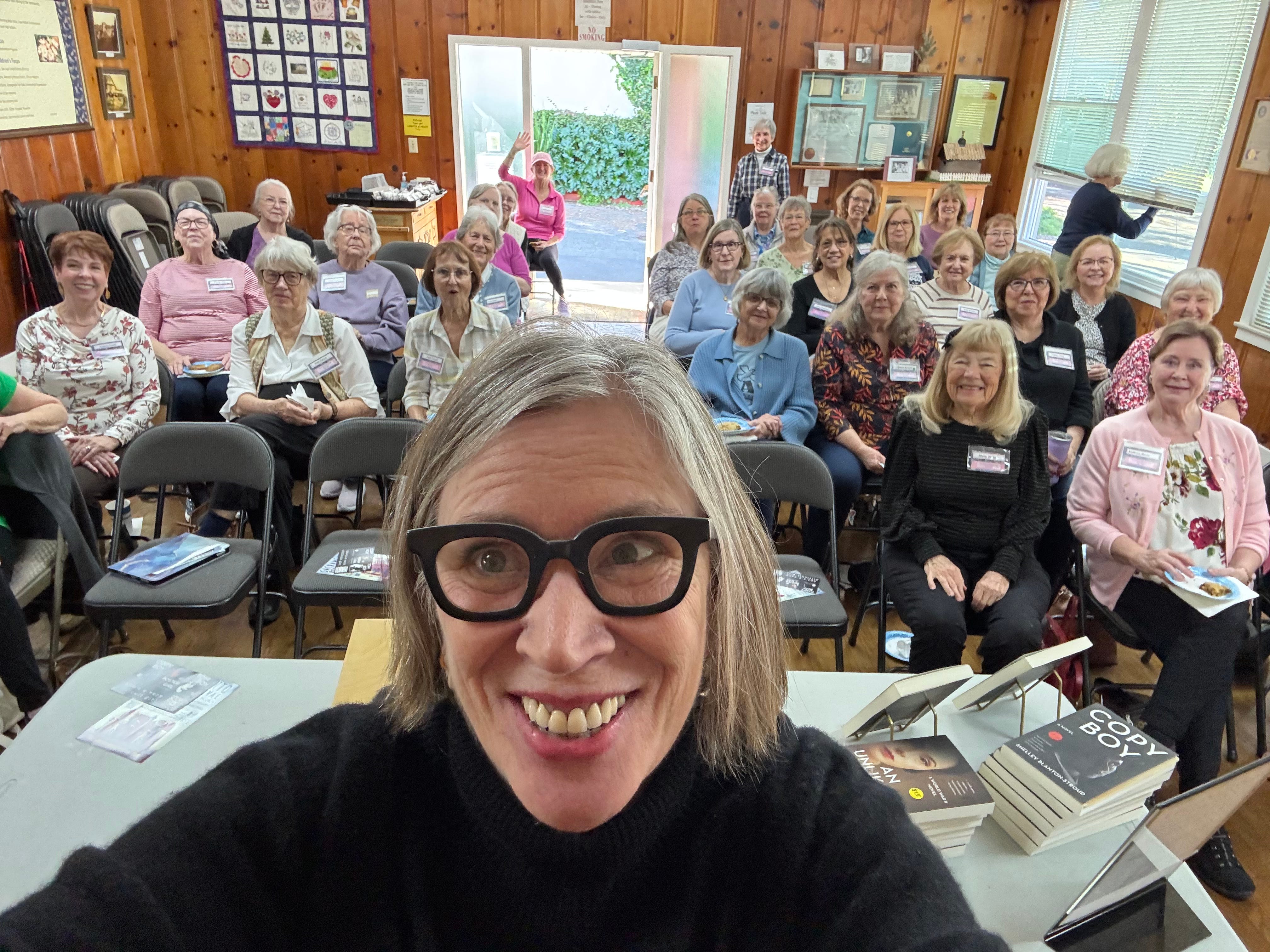
Truly happy at the Fair Oaks Thursday Women’s Book Club.
Sometimes I look at the selfies I take at book clubs and conferences and think I look kind of unhinged—eyes too wide, smile too big, slightly manic. But those pictures also make me laugh, because that’s exactly how I feel when I get to these events. That open, ridiculous, fully alive feeling. I look at those photos and think: it’s working.
The calendar has been very bookish lately and that trend will continue. This month I’ll travel to Beverly, Massachusetts for the History Through Fiction conference to appear on a panel with Jody Hadlock, Joan Griffin and Terri Lewis to talk about some things we’ve learned about truth and facts while writing historical fiction. Expect to see another slightly unhinged smiley photo coming your way soon. I’m grateful to share it.
"Not soft - open"... beautiful words. Thanks for them today ❤️
Shelley, thank you for your beautiful, open-handed, open-hearted words. Very, very needed right now (by me and, I suspect, by most people).